




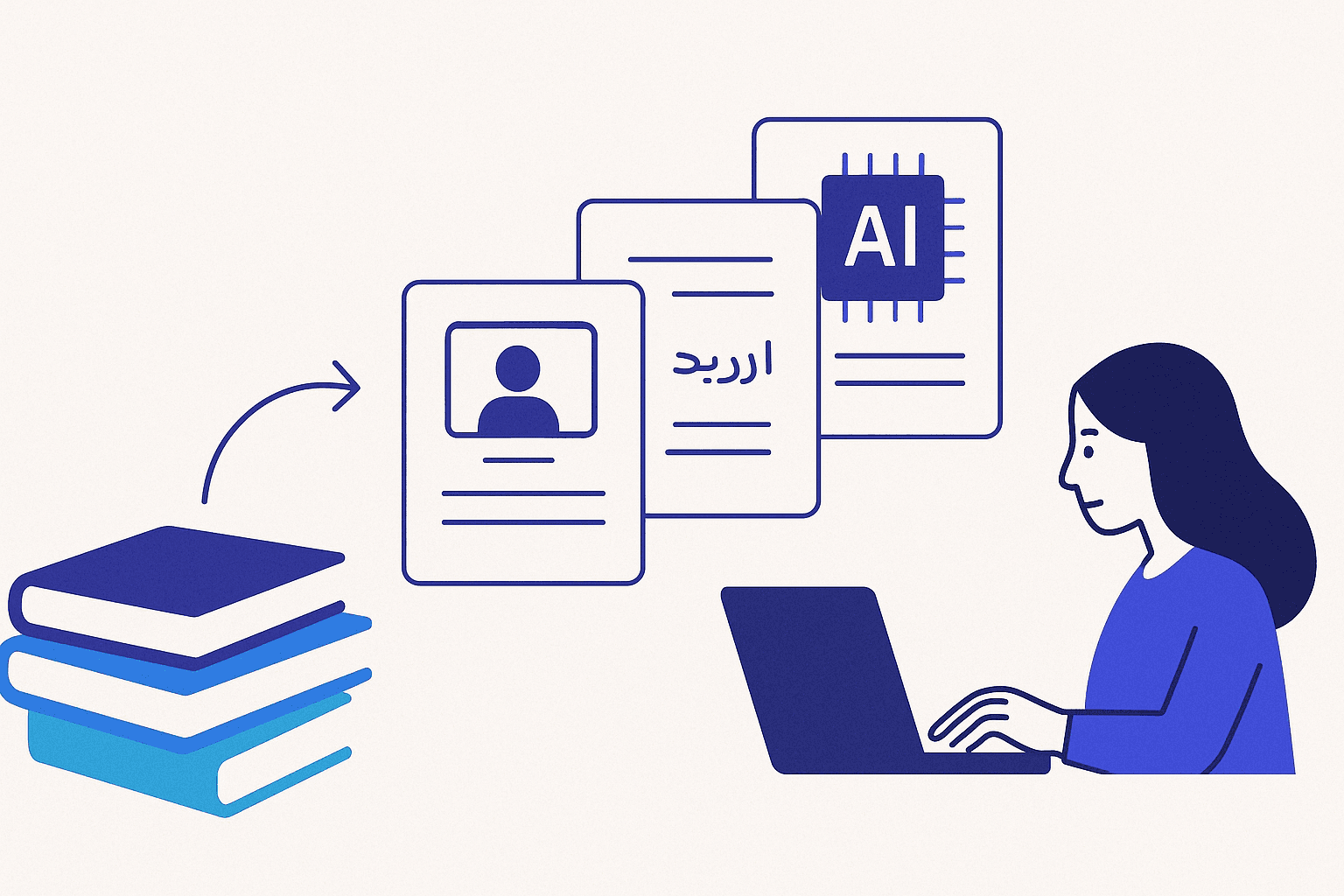
An Arabic AI tutor is not the same as an English tutoring tool whose buttons have been swapped into Arabic. A true Arabic-first AI tutor is built right-to-left (RTL) from the ground up, and — more importantly — it thinks, chats, speaks and generates study material in Arabic. Most AI study apps simply translate their interface labels while the underlying model still reasons in English and the layout still flows left-to-right (LTR). That gap is exactly where the learning experience breaks down.
This article explains the difference between translation and a native Arabic AI tutor, why it matters for real study outcomes, and how Intrazero's iTutor approaches Arabic as a first-class language rather than an afterthought.
Translation vs. an Arabic-First AI Tutor
Translation swaps English words for Arabic ones. An Arabic-first AI tutor rebuilds the whole experience around the language — the chat, the voice, the generated flashcards, and the layout. The two feel completely different, even when the words on screen look correct.
What a "translated" tutor usually means
- Mirrored text, LTR structure: Menus, progress bars and chat bubbles still start on the left, forcing the eye to fight the natural reading direction.
- English reasoning in disguise: The AI answers a translated question with translated logic, missing the Arabic phrasing, idioms and curriculum context a student actually wrote in.
- Broken typography: Arabic is a cursive, connected script. Fonts chosen for Latin text clip diacritics, misalign baselines, or break letter joining in generated notes and quizzes.
- Mixed-direction chaos: Numbers, formulas, URLs and English terms inside Arabic answers need proper bidirectional handling. Translated tools frequently scramble the order.
What an Arabic-first AI tutor actually requires
- Native RTL layout: The whole grid flips — navigation, chat, voice controls and flashcards originate on the right.
- Arabic chat and Arabic voice: A tutor that converses by text and by voice in Modern Standard Arabic — part of 12 supported languages — so a student can ask in Arabic and hear the answer in Arabic.
- Material-grounded answers: Responses drawn from the student's own uploaded Arabic notes, slides and textbooks — not generic web text — so the tutor stays on-syllabus.
- Correct Arabic typography and BiDi intelligence: Latin brand names, numbers and technical terms stay legible inside Arabic prose without disrupting the flow.
Why Arabic-First Done Right Improves Learning
Language and direction are not cosmetic. When the tutor reads, replies and lays out content the way a learner actually reads, cognitive load drops and attention stays on the subject instead of the interface. A translated tutor forces constant micro-corrections — re-reading a mislaid label, decoding an answer that was clearly reasoned in English — and those frictions accumulate into disengagement.
For Arabic-speaking students, teachers and institutions, a genuine Arabic AI tutor also signals credibility. Material explained in Arabic, quizzed in Arabic, and revised in Arabic feels native to the learner rather than borrowed from another market. With 10,000+ learners and 5,000+ subjects covered, that native fit is what keeps students studying.
What a True Arabic AI Tutor Actually Does
iTutor is an Arabic-first AI tutoring platform with native RTL support — and that native support is the core differentiator from tools that only translate. Because the Arabic foundation is built in, every study feature works with Arabic content rather than around it:
- AI tutor chat and voice in Arabic: Ask a question by text or by voice and get a clear, on-topic explanation in Arabic, across 12 languages when you need them.
- Auto-generated study materials: Flashcards, quizzes and practice exams generated directly from the student's own Arabic materials, so revision matches what they are actually studying.
- Study guides grounded in your sources: Summaries and study guides built from your uploaded notes and textbooks, keeping answers accurate and on-syllabus instead of generically web-sourced.
- 23 AI content generators: A full toolkit — from lesson explanations and outlines to questions and revision aids — that produces structured Arabic study content rather than machine-translated English.
- A study planner: A schedule that organizes topics and revision sessions so learners know what to study next.
iTutor holds a 4.8/5 rating, supports native Arabic RTL throughout, and is designed around the Arabic-speaking market rather than retrofitted to it. It integrates with the systems institutions already run, but it is an AI tutor — not a learning management system.
Who Benefits From a Native Arabic AI Tutor
The advantage of an Arabic-first tutor shows up differently for each audience, but it lands for all three:
- Students: Get explanations, flashcards and practice exams in the language they study in, grounded in their own materials — so revision is faster and answers actually match the syllabus.
- Teachers: Generate Arabic lesson material, quizzes and study guides in minutes with the 23 content generators, instead of hand-formatting LTR tools into readable Arabic.
- Institutions: Offer learners a credible native-Arabic experience that integrates with the tools they already use, without forcing students through a translated English shell.
The Hidden Costs of a Translation-Only Approach
The problems with a translated tutor rarely show up in a demo. They surface later, in places that are expensive to fix:
- Wrong-language reasoning: An AI that thinks in English and answers in translated Arabic can miss the nuance of how a question was actually asked, producing answers that are technically fluent but off-target.
- Content rework: Generated notes authored in an LTR pipeline often need manual reformatting to read correctly in Arabic — especially tables, lists and anything mixing Arabic with numbers or Latin terms.
- Disengagement: If chat bubbles, flashcards and quiz layouts mirror incorrectly, learners drift away — a retention problem, not just a cosmetic one.
- Trust: A patchy Arabic interface signals that Arabic users are a secondary audience, which undermines adoption in exactly the schools and universities you are trying to win.
How to Evaluate an Arabic AI Tutor
When comparing tools, look past the translated menu labels and test the tutor the way your learners will. A short evaluation checklist:
Test the full Arabic journey, not the homepage
- Ask the tutor a real question in Arabic by text and by voice — confirm the explanation reads and sounds like native Arabic, not translated English.
- Upload your own Arabic notes and generate flashcards, a quiz and a study guide — check they are grounded in your material and read naturally from the right.
- Mix Arabic with numbers, a formula, a date and an English term, then confirm the bidirectional ordering stays correct.
Check that the AI features speak Arabic
- Run a few of the 23 content generators and judge whether the output reads as native Arabic writing or translated English.
- Confirm the study planner and practice exams operate on Arabic subjects, not just Latin-script ones.
- Verify any integrations you depend on connect without breaking the Arabic experience.
Frequently Asked Questions
Isn't a translated English AI study app enough?
For basic text it can work, but translation leaves the LTR structure, the typography and — crucially — the English reasoning untouched. An Arabic-first AI tutor like iTutor rebuilds those layers so the chat, voice and generated material read naturally in Arabic.
Does Arabic-first mean Arabic-only?
No. iTutor supports 12 languages and handles mixed content — Latin brand names, numbers and technical terms stay readable inside Arabic answers.
Is iTutor an LMS?
No. iTutor is an AI tutoring platform that integrates with the systems institutions already use; it adds AI chat, voice, generated study materials and a planner rather than replacing your LMS.
Give Arabic Learners a Tutor Built for Arabic
If your learners study in Arabic, their AI tutor should be built for Arabic — not translated into it. To see how a native Arabic-first approach works in practice, explore iTutor's Arabic AI tutor or contact our team for a walkthrough.
Abdulrahman Sayed
Contributor