




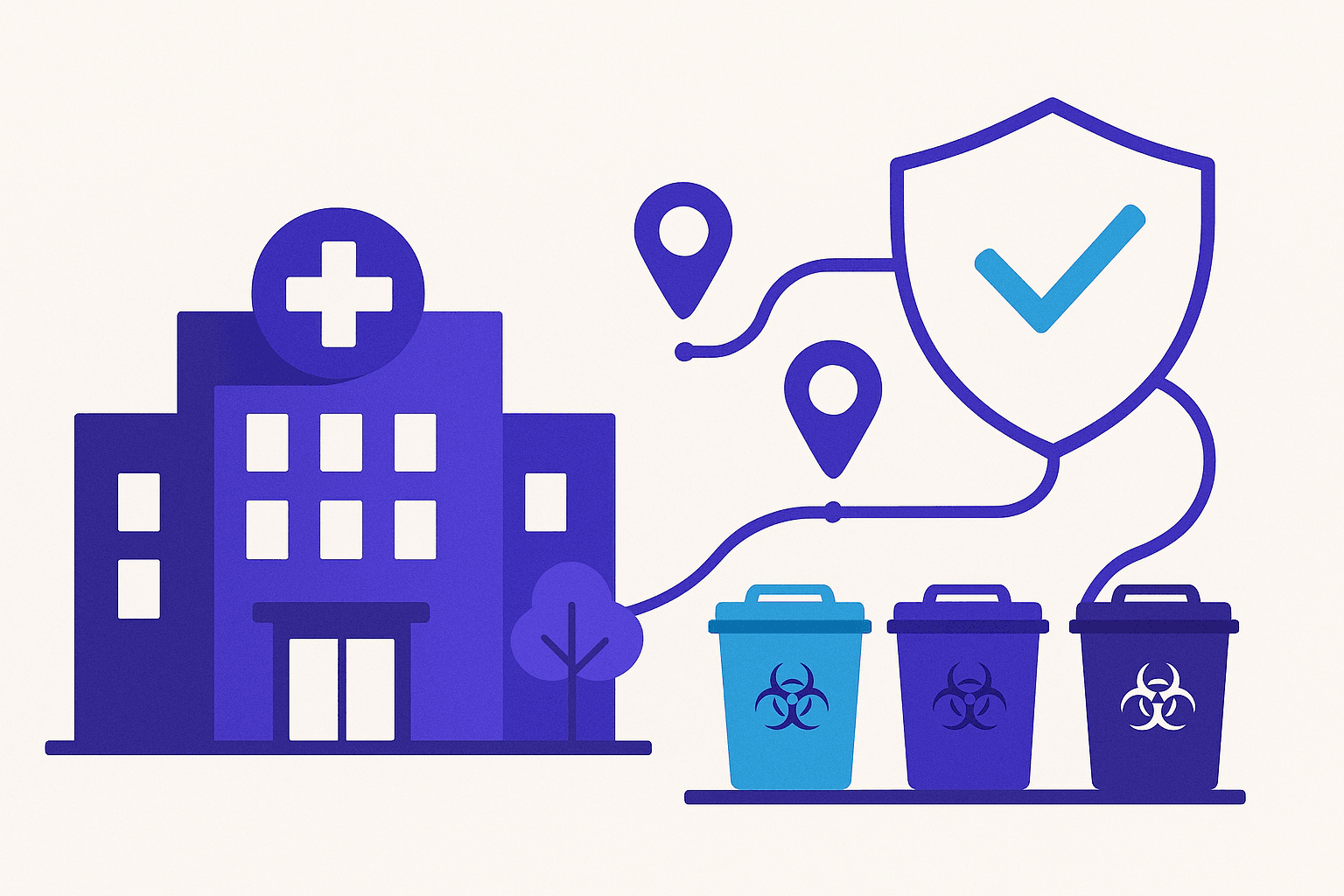
In Egypt, medical waste is legally classified and handled as hazardous waste. The core medical waste regulations Egypt applies are anchored in Environment Law No. 4 of 1994 (and its amendments), enforced by the Egyptian Environmental Affairs Agency (EEAA) under the Ministry of Environment, alongside infection-control standards from the Ministry of Health and Population (MoHP). In short: healthcare facilities must segregate waste at the source using WHO-aligned color coding, store it safely, and hand it only to licensed transporters and treatment facilities — with documented chain of custody at every step.
Who regulates medical waste in Egypt?
Three authorities shape day-to-day compliance for any hospital, clinic, lab, or pharmacy:
- Ministry of Environment / EEAA — treats medical waste as hazardous waste under Law No. 4 of 1994, oversees permits for transport and treatment, and inspects generators.
- Ministry of Health and Population (MoHP) — sets infection-prevention and control standards for handling, packaging, and on-site storage inside healthcare facilities.
- Governorate authorities — coordinate local enforcement and licensed collection across Egypt's 27 governorates.
Because the waste is classified as hazardous, the obligations are stricter than for ordinary municipal refuse: generators remain accountable for their waste until it is verifiably treated or destroyed. This is known as the "cradle-to-grave" principle, and it means liability does not end when the collection truck leaves your gate.
What counts as medical waste?
Not everything a healthcare facility discards is regulated as hazardous. Understanding the boundary is the first step toward correct segregation and cost control. Under the medical waste regulations Egypt applies, the regulated streams typically include:
- Infectious waste — materials contaminated with blood or other potentially infectious fluids, cultures, and stocks of infectious agents.
- Sharps — needles, syringes, scalpels, lancets, and broken glass, whether or not they are contaminated.
- Pathological waste — human tissues, organs, and body parts.
- Pharmaceutical and chemical waste — expired or unused medicines, disinfectants, and laboratory reagents.
General office and food waste that has not been in contact with patients is non-hazardous and can follow the ordinary municipal stream — provided it has been kept genuinely separate from the regulated streams.
How should medical waste be segregated?
Compliant segregation in Egypt follows the internationally recognized, WHO-aligned color-coded scheme. Mixing streams is one of the most common and most penalized violations, because a single infectious item can contaminate an entire bin of otherwise general waste.
The color-coded categories
- Yellow — infectious and pathological waste (blood-soaked materials, tissues, cultures).
- Red — other highly infectious or contaminated items, depending on facility protocol.
- Puncture-proof sharps containers — needles, scalpels, broken glass.
- Black — general, non-hazardous waste that may follow the municipal stream.
Segregation must happen at the point of generation. Once streams are mixed, the entire batch is treated as hazardous, raising cost and regulatory exposure.
Transport, treatment, and disposal
Under Egyptian regulations, medical waste can only move with licensed transporters and be processed at licensed treatment facilities. Common compliant treatment methods include autoclaving (steam sterilization) and high-temperature incineration, after which residues are disposed of as regulated waste. The generating facility cannot simply hand waste to an unlicensed third party — doing so breaks the legal chain of responsibility and exposes the facility to penalties under the hazardous-waste provisions of Law No. 4 of 1994.
What are the risks of non-compliance?
Treating medical waste as hazardous waste means the consequences of getting it wrong go beyond a fine. Because oversight sits with the EEAA and the Ministry of Health and Population, a facility that mishandles waste can face several overlapping risks:
- Regulatory penalties under the hazardous-waste provisions of Law No. 4 of 1994 and its amendments.
- Operational disruption if inspections reveal improper storage, missing permits, or use of unlicensed contractors.
- Infection-control exposure that endangers staff, patients, and waste handlers.
- Reputational damage, which matters for hospitals competing for accreditation, partnerships, and patient trust.
The common thread is that almost all of these risks are preventable with disciplined segregation and, critically, the ability to prove what happened to each batch.
Proving compliance: chain of custody
The single hardest part of medical waste regulations Egypt enforces is not segregation — it is proof. Regulators and auditors expect a defensible record showing each batch from the moment it is bagged to the moment it is destroyed. Paper manifests are easy to lose, backdate, or falsify, which is why digital tracking has become the practical standard.
Intrazero's medical waste management software, MedWaste, builds an auditable chain of custody using GPS, barcode, and RFID tracking. Every container is identified at the source and followed through collection, transport, and treatment, so a facility can demonstrate exactly where its hazardous waste went and when. MedWaste is WHO-aligned and has been deployed across all 27 Egyptian governorates under a UNICEF-funded program, supporting a 100% compliance rate for the facilities using it.
What a digital system replaces
- Manual logbooks with a tamper-resistant, timestamped digital trail.
- Guesswork at audit time with on-demand reports tied to each barcode/RFID tag.
- Blind spots in transit with GPS-tracked custody from generation to treatment.
A 2026 compliance checklist for facilities
- Register as a hazardous-waste generator and keep environmental permits current.
- Segregate at the source using WHO-aligned color coding and sharps containers.
- Store waste safely on-site per MoHP infection-control standards.
- Contract only EEAA-licensed transporters and treatment facilities.
- Maintain a complete, verifiable chain of custody for every batch.
- Train staff and keep records ready for unannounced inspection.
Frequently asked questions
Is medical waste considered hazardous waste in Egypt?
Yes. It is regulated as hazardous waste under Environment Law No. 4 of 1994 and its amendments, which is why generators carry extended responsibility for it.
Which authority enforces medical waste rules?
The EEAA under the Ministry of Environment handles the hazardous-waste and permitting side, while the Ministry of Health and Population sets infection-control standards inside facilities.
Do small clinics and labs have to comply?
Yes. The regulations apply to any generator of healthcare waste, regardless of size; the same segregation, licensing, and documentation duties apply.
How do we prove our waste was properly treated?
By maintaining a chain of custody from bagging to treatment. Digital tracking with barcode/RFID and GPS — as in MedWaste — provides audit-ready evidence on demand.
Get compliant with confidence
Meeting the medical waste regulations Egypt enforces is no longer about more paperwork — it is about provable, end-to-end tracking. Intrazero (Cairo-HQ, founded 2016, trusted by 500+ institutions) built MedWaste to turn compliance into a defensible, automatic record. Contact our team to see how GPS, barcode, and RFID chain-of-custody tracking can protect your facility and keep you audit-ready.
Mohamed Gamal
Contributor