




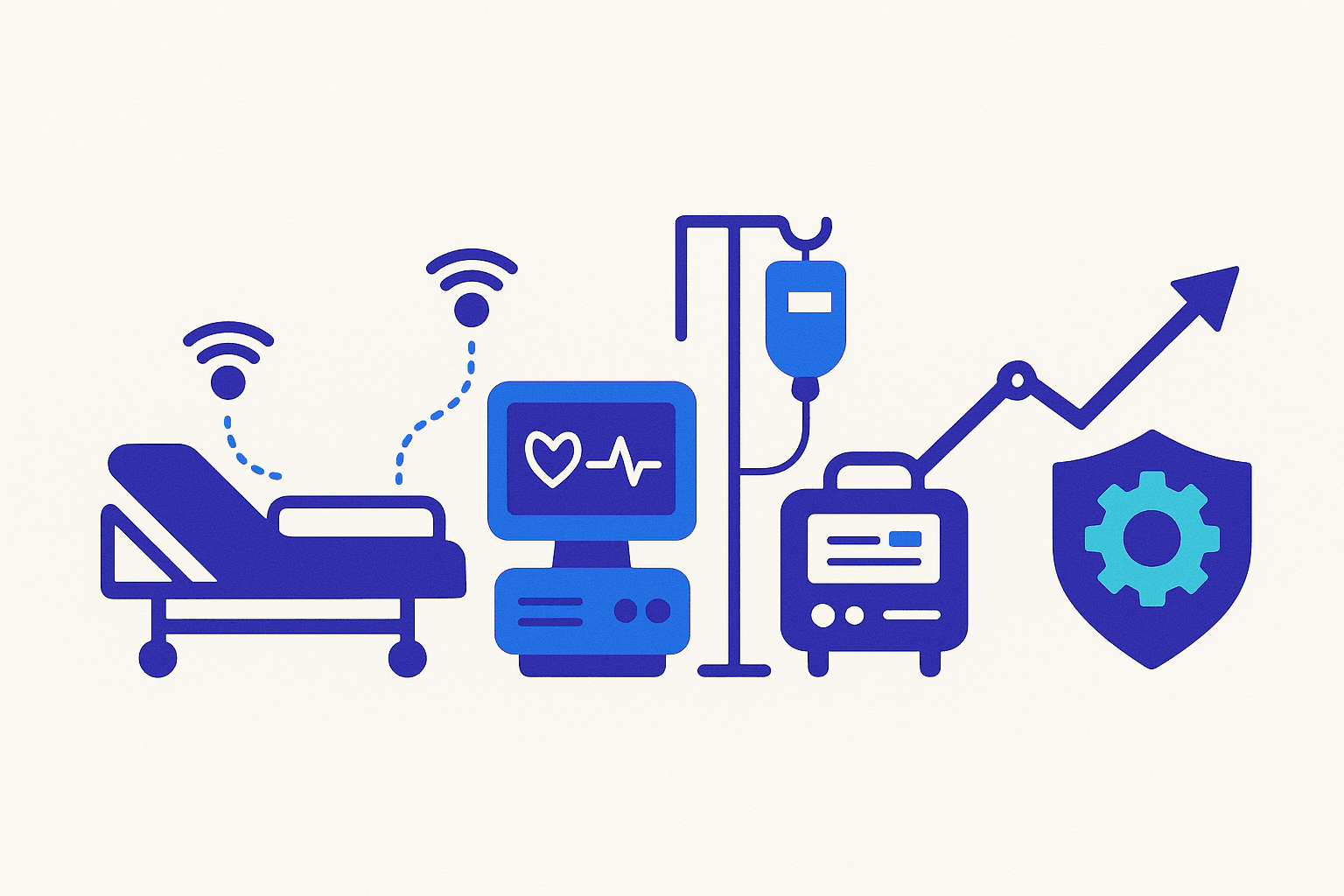
To reduce hospital equipment downtime, shift from reactive break-fix repairs to predictive maintenance: use IoT sensors and a healthcare CMMS to monitor device condition in real time, flag early warning signs, and schedule service before a failure takes a critical asset offline. Hospitals that make this shift typically recover lost availability fast. In the Saudi Ministry of Health (MOH) Tabuk Cluster, Intrazero's iAssets platform helped 27 hospitals achieve a 40% reduction in equipment downtime using exactly this approach.
Why hospital equipment downtime is so costly
An idle MRI, ventilator, or infusion pump is not just a maintenance line item. Downtime delays diagnoses, forces patient transfers, idles expensive clinical staff, and erodes the safety margins that accreditation bodies such as JCI and CBAHI expect you to maintain. The traditional approach makes this worse:
- Reactive maintenance waits for the device to fail, so the first sign of trouble is an outage during a procedure.
- Calendar-based preventive maintenance services everything on a fixed schedule whether it needs it or not, wasting technician hours while still missing failures that develop between visits.
Predictive maintenance closes that gap by acting on the actual condition of each asset instead of guesswork.
What predictive maintenance actually does
Predictive maintenance combines continuous monitoring with analytics to forecast when a specific machine is likely to fail, then intervenes during a planned window rather than an emergency. For medical equipment this rests on a few building blocks:
1. IoT condition monitoring
Sensors track the parameters that precede failure: temperature, vibration, motor current, pressure, runtime hours, and error codes streamed from the device itself. Instead of a quarterly inspection, you get a live signal of how each asset is behaving today.
2. A healthcare CMMS as the system of record
A computerized maintenance management system (CMMS) ties those signals to the asset register, warranty data, service history, and spare-parts inventory. When a reading drifts out of range, the CMMS opens a work order, assigns the right biomedical technician, and confirms the part is in stock, so the fix is ready before the machine actually breaks. iAssets is a healthcare-specific CMMS built for this workflow.
3. Early-warning alerts and analytics
Thresholds and trend analysis turn raw data into action. A slowly rising bearing temperature or a creeping rise in pump pressure triggers an alert days or weeks ahead of failure, giving the team time to schedule service at night or during low-utilization hours. That is the core mechanism that lets you reduce hospital equipment downtime without adding staff.
A practical rollout plan
You do not need to instrument every device at once. A focused program delivers results faster:
- Build a complete asset inventory. Tag every device (RFID or barcode) and load it into the CMMS so nothing falls through the cracks.
- Prioritize critical and high-cost assets. Start with imaging, life-support, and sterilization equipment where an outage hurts patients and budgets most.
- Connect IoT monitoring to the priority fleet. Capture the failure-predictive parameters that matter for each device class.
- Define alert thresholds and escalation rules. Decide who is notified, how fast, and what the standard response is.
- Track the right KPIs. Monitor uptime, mean time between failures (MTBF), mean time to repair (MTTR), and PM completion rate, then expand the program as the numbers improve.
You can see how these pieces fit together on our predictive maintenance for hospitals solution page.
The business case beyond uptime
Reducing downtime is the headline benefit, but a predictive program pays back in several other ways that finance and clinical leaders care about:
- Lower repair costs. Catching a worn bearing or a drifting calibration early is far cheaper than replacing a motor or a board after a catastrophic failure, and it avoids rush-shipping charges for emergency parts.
- Longer asset life. Servicing devices based on real condition keeps them within their operating envelope, extending the useful life of capital equipment and deferring replacement spend.
- Audit-ready compliance. A CMMS keeps a complete, timestamped record of every work order, calibration, and PM event, so accreditation surveys for JCI and CBAHI become a matter of running a report rather than reconstructing history.
- Smarter staffing. When technicians work scheduled, data-driven tasks instead of reacting to emergencies, the same team covers more devices with less overtime.
Together these effects turn maintenance from a pure cost center into a lever for both patient safety and budget control.
Proof at scale: the MOH Tabuk Cluster
Intrazero deployed iAssets across the Saudi MOH Tabuk Cluster, covering 27 hospitals, as part of a portfolio that spans 3,000+ healthcare facilities. By combining IoT predictive maintenance with a centralized healthcare CMMS, the cluster reached a 40% reduction in equipment downtime while keeping operations aligned with MOH, JCI, and CBAHI requirements. iAssets runs in the cloud or on-premise, so it fits both centralized health authorities and individual hospitals with their own data-residency rules.
Frequently asked questions
What is the difference between preventive and predictive maintenance?
Preventive maintenance follows a fixed calendar schedule regardless of condition. Predictive maintenance uses real-time data to service a device only when its actual condition indicates a developing problem, which cuts both unnecessary work and surprise failures.
Do we need to replace our existing medical devices to use predictive maintenance?
No. Most programs add IoT condition monitoring to existing equipment and integrate it with a CMMS such as iAssets, so you protect your current investment rather than replacing it.
How quickly can a hospital reduce equipment downtime?
Results depend on asset mix and data quality, but the Tabuk Cluster's 40% downtime reduction shows what a centralized, IoT-driven program can achieve across a large fleet.
Reduce your equipment downtime with iAssets
Predictive maintenance turns your biomedical team from firefighters into planners, protecting patient care and your capital budget at the same time. If you want to reduce hospital equipment downtime across your facility or cluster, contact the Intrazero team to see how iAssets can be deployed in your environment.
Mohamed Gamal
Contributor